
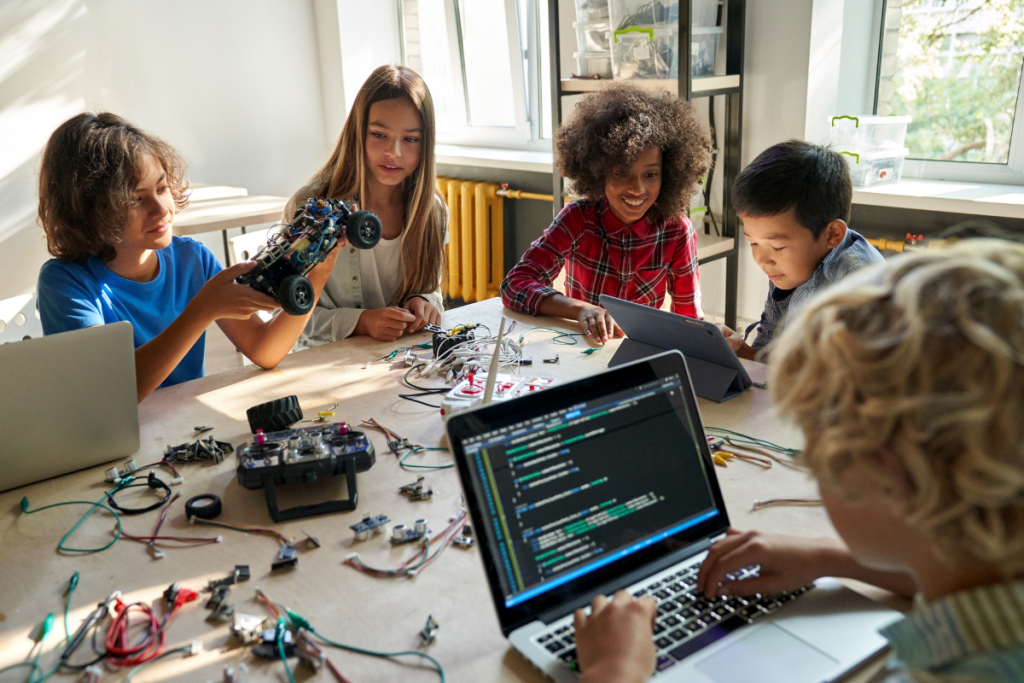
Jakarta, incaschool.sch.id – In a world shaped by software, automation, and digital systems, learning how code works has become increasingly valuable for students across many fields. That is why a Coding Class can play such an important role in education. It introduces students to programming basics while helping them build logical thinking, structured reasoning, and digital problem-solving skills. More than a technical subject, coding becomes a way of learning how to break down problems, test solutions, and improve ideas through careful practice. When taught well, a coding class gives students both foundational knowledge and greater confidence in working with technology.
Why a Coding Class Matters

A Coding Class matters because it helps students understand the systems they use every day. Many learners interact constantly with apps, websites, devices, and digital tools without fully understanding the logic behind them. Coding education helps close that gap by showing how instructions are structured, how programs respond to input, and how digital solutions are built step by step.
This becomes especially important because programming is not only useful for future software developers. It also supports broader academic and professional abilities. Students who learn coding often improve in problem analysis, attention to detail, persistence, and computational thinking. These skills can transfer into science, business, design, engineering, research, and many other areas.
There is also a strong connection to digital literacy, computational thinking, programming fundamentals, algorithmic reasoning, software learning, logical problem-solving, and technology education here. A strong understanding of the Coding Class is not simply about writing code. It is about learning how to think clearly and solve digital problems in a structured way.
My Perspective on Learning to Code
What changed my understanding of the Coding Class was realizing that its greatest value often lies in mindset rather than syntax alone. At first, some may think coding education is mainly about learning commands, symbols, and technical rules. But over time, it becomes clear that students are also learning how to test ideas, accept mistakes, debug problems, and improve solutions gradually. Coding teaches patience as much as precision.
That is what makes this topic meaningful. A coding class is not only about programming languages. It is also about helping students build confidence in reasoning, experimentation, and digital creativity.
Core Skills Students Learn in a Coding Class
The value of the Coding Class becomes clearer when its main learning outcomes are broken down directly.
Programming basics
Students learn core ideas such as variables, conditions, loops, and functions.
Logical thinking
Coding teaches learners to organize steps in a clear and structured order.
Problem decomposition
Students practice breaking large problems into smaller, manageable parts.
Debugging
They learn how to identify errors, test solutions, and improve code.
Algorithmic reasoning
Students begin to understand how procedures can be designed to solve tasks efficiently.
Persistence and revision
Coding often requires repeated testing, which helps students build resilience.
How a Coding Class Supports Student Development
I have noticed that a Coding Class becomes especially effective when it connects technical learning with active problem-solving.
It promotes structured thinking
Students learn to approach problems step by step rather than randomly.
It supports active learning
Writing and testing code requires participation, not passive memorization.
It builds digital confidence
Students become more comfortable working with technology at a deeper level.
It encourages creativity within logic
Programming allows students to create projects while following clear rules.
It prepares students for future opportunities
Coding skills are increasingly relevant in academic, professional, and entrepreneurial settings.
Common Challenges in Coding Education
The Coding Class also presents challenges that teachers and students need to manage thoughtfully.
Fear of complexity
Some students feel intimidated by technical language or unfamiliar symbols.
Frustration with errors
Bugs and failed code can discourage beginners if support is weak.
Uneven experience levels
Some students may already know basic programming while others are complete beginners.
Overemphasis on memorization
Students learn better when concepts are applied, not only remembered.
Limited practice time
Programming skill usually improves through repeated hands-on work.
Practical Ways to Strengthen a Coding Class
I believe a Coding Class becomes more successful when instruction is clear, incremental, and practical.
Start with simple concepts
Students build confidence more easily when early tasks are manageable.
Use project-based learning
Small real tasks make abstract ideas easier to understand.
Normalize mistakes
Debugging should be presented as part of learning, not as failure.
Encourage collaboration
Pair work and discussion can make coding less intimidating.
Connect coding to real outcomes
Students often stay more motivated when they can see what their code creates or solves.
Below is a simple overview of how a coding class supports learning:
| Coding Class Area | Why It Matters | Example in Practice |
|---|---|---|
| Programming basics | Builds technical foundation | Students learn variables, loops, and conditional statements |
| Logical thinking | Improves structured reasoning | A learner writes step-by-step instructions for a task |
| Problem-solving | Supports digital analysis | Students design code to solve a simple classroom problem |
| Debugging | Develops persistence | A student tests code, finds an error, and fixes it |
| Project creation | Connects learning to output | Students build a basic calculator or interactive program |
These examples show that a Coding Class is not simply a technical lesson. It is a learning environment where students develop programming basics and digital problem-solving skills through structured practice.
Why a Coding Class Matters Beyond the Classroom
The importance of a Coding Class extends beyond one subject area. It helps students become more confident users and creators of technology, strengthens their ability to think systematically, and prepares them for a world where digital systems shape daily life and future work. Even students who do not pursue programming careers can benefit from the habits of logic, persistence, and structured experimentation that coding develops.
That broader significance is what makes this topic so valuable. A coding class is not only about teaching code. It is also about helping students build a stronger foundation for learning, problem-solving, and participation in a digital world.
Final Thoughts
For me, the Coding Class is one of the most valuable educational experiences for students because it combines technical knowledge with practical thinking. It helps learners understand programming basics while building digital problem-solving skills that remain useful across many academic and professional contexts.
That is why it matters so much. A Coding Class is not simply a lesson in syntax. It is a structured learning experience that teaches students how to think logically, solve problems carefully, and engage with technology more confidently.
Explore our “”Knowledge“” category for more insightful content!
Don't forget to check out our previous article: Computer Lab: Building Digital Skills Through Technology-Based Learning Activities